
Scott County Sex Offender Checks
The Iowa Sex Offender Registry is the main public source for a Scott County search. The Iowa Department of Public Safety Division of Criminal Investigation, or DCI, runs it. The registry has operated since July 1995 and joins data supplied through sheriffs with the state platform. Ordinary data updates are typically made each hour during weekday business hours. That makes the Iowa profile the first place to verify an Iowa registration detail, while the Scott County Sheriff handles the local registration role.
Choose the tool by purpose. An exact name search works for a known person. Alias search can catch a different registered name. A ZIP or map query serves location-based awareness. Phone and email tools check whether a contact detail is tied to a registrant. The map is useful, but its symbols should not be treated as a promise that no other risk exists nearby. Absence from the search is not a safety guarantee, and a listing is not a forecast that someone will offend again.
Five Scott County Registry Search Routes
Iowa provides several paths within one registry rather than a separate Scott County database. Start with the narrowest facts you know, then broaden only when needed. The public interface covers name, aliases, geography, telephone, and email. A map search can help with a place, while a telephone or email query answers a very different question about a contact point.
The official registry search screen shows the basic search entry point and links to the other modes.
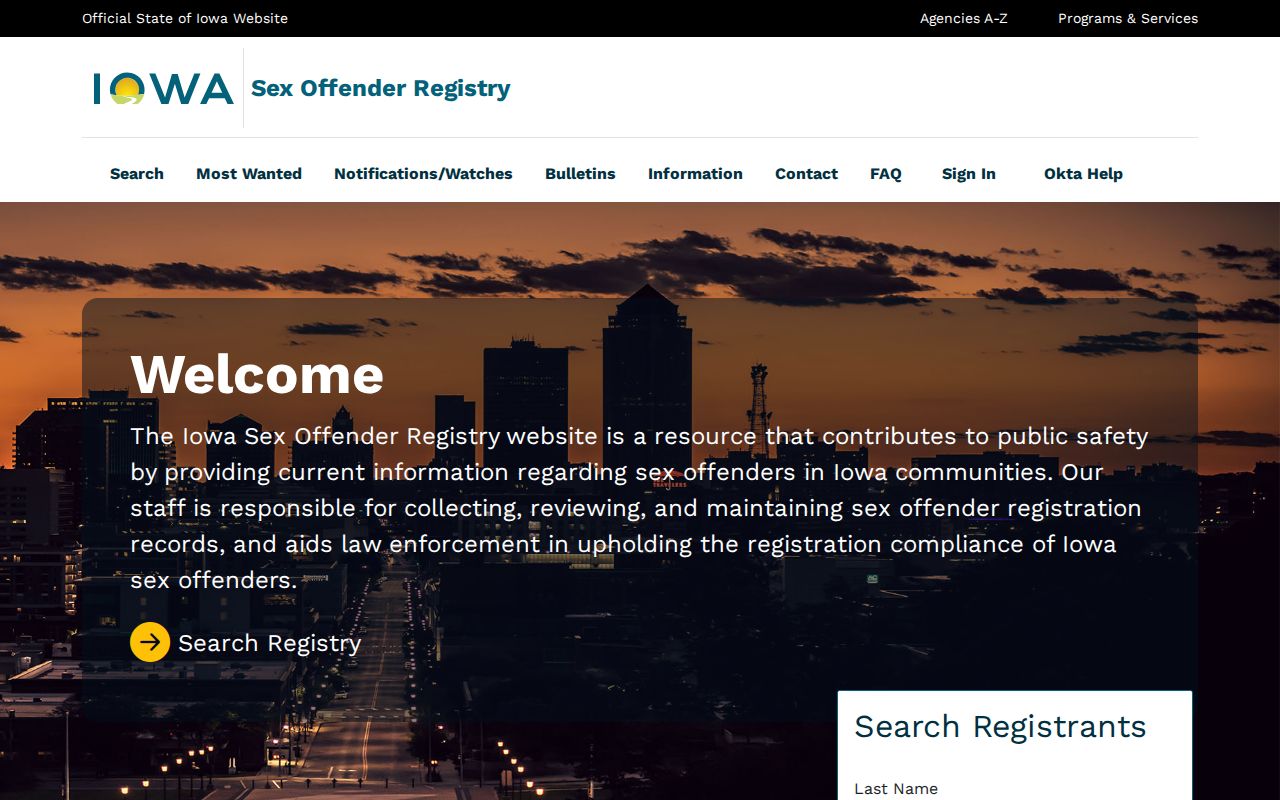
That screen is the direct state source for Scott County registry results, not a copied list from a private site.
Use aliases when a name query seems incomplete. For a location search, enter the address or geographic detail the live map requests and confirm the map options shown at that time. A phone or email query can verify an association, but it does not reveal every contact method a person may use.
Iowa Sex Offender Registry Searches
A careful Scott County registry search keeps the query simple and checks the result against the profile itself. The search does not require a paid account. A free Iowa Okta account is needed only for watches and alerts. Avoid combining uncertain facts that might hide a valid result.
- Open the Iowa registry and choose the basic, advanced, map, telephone, or email route that fits the question.
- Enter a last name, add a first name or ZIP when useful, and select alias search if another name may be registered.
- Review the result list without assuming two similar names refer to the same person.
- Open the Iowa profile and read the status, tier, qualifying offense, address, and update context together.
- For a location that may cross state lines, repeat the search through the national registry layer.
| Search Field | Type | Required | Use |
|---|---|---|---|
| Last Name | Text | Conditional | Basic name starting point |
| First Name | Text | No | Narrows a name result |
| Also Search Aliases | Checkbox | No | Includes known aliases |
| ZIP Code | Text | No | Five-digit location filter |
| Advanced Criteria | Text and choices | No | Adds traits or location facts offered live |
| Map Search | Address and map | Conditional | Uses geographic registry data |
| Telephone or Email | Text | Conditional | Checks an association with a registrant |
| Notifications and Watches | Account workflow | Account required | Creates and manages free watches |
Search results are leads to an official profile, not stand-alone proof about a person. Check aliases, the listed county, and the qualifying-offense detail before relying on a match. If the query involves a Scott County location near the Mississippi, repeat it through the national route so the state line does not cut off the search.
Scott County Registry Office Role
Iowa Code section 692A.120 assigns local registration work to the sheriff. In Scott County, begin with the Scott County Sheriff's Office at 400 W. Fourth Street in Davenport or call 563-326-8625. Confirm the appointment and service location before travel because patrol and administrative functions can be split. The sheriff is the proper local contact for registration logistics and a suspected failure to comply, while DCI maintains the state public platform. Section 692A.110 authorizes an annual registration fee and civil penalties, but the current local amount should be confirmed with the sheriff.
The Scott County government directory is a sound route for checking an office link or contact change. A person seeking a court order under Iowa's limited registry-modification statute should use the court process, not ask the sheriff to erase a state profile. The Scott County Clerk of District Court at the Scott County Courthouse is the local court-record contact, though the research does not support promising that any person qualifies for modification.
Note: Report suspected noncompliance to the sheriff or DCI, and use 911 only for an emergency rather than a routine registry question.
Registry Profiles: What They Show
A public profile collects the facts chapter 692A makes available. It may show a photo, current and other names, aliases, physical traits, residence and county, registration status, tier, and qualifying offense details. It may also list scars, marks, tattoos, vehicles, telephone numbers, email, school, or other registered information when the statute permits and the record contains those fields. Missing content does not prove that DCI or law enforcement holds no additional data.
| Name and Aliases | Current name plus other registered names or aliases. |
|---|---|
| Photo and Description | Photo and available age, sex, race, height, weight, hair, eyes, scars, marks, or tattoos. |
| Residence and County | Public address or residence data and the county tied to the registration. |
| Offense Detail | Qualifying offense, jurisdiction, statute, and conviction information when public. |
| Tier | Iowa classification tied to the qualifying offense and repeat-history rules. |
| Status and Updates | Registration status and available verification or update context. |
| Other Registered Facts | Vehicle, phone, email, school, or other data when public and present. |
Read the fields as one record. A current address does not change the tier, and a tier does not explain every special sentence or tolling rule. When a photo or contact field is absent, use the sheriff or DCI route for a suspected data problem rather than trying to fill the gap through private sources.
Scott County Registry Change Alerts
A free Iowa Okta account lets a user create and manage registry watches. Iowa says an alert is sent within 60 minutes after a change to registered information. That timing is more useful for ongoing awareness than repeatedly running the same Scott County name or map search. It is still an alert about a registry update, not a real-time location tracker or proof of what occurred between updates.
Set the watch from the notification workflow shown on the official registry. Keep the search area and contact settings current. If an alert points to an unexpected address or status, open the current Iowa profile before drawing a conclusion. Contact the sheriff when a Scott County profile seems stale. Do not confront a registrant or try to investigate compliance yourself.
Registration Levels and Duties in Iowa
Iowa uses three tiers, and the general duration rises with the classification. The qualifying offense controls the initial tier, while repeat qualifying history can move a person higher. Iowa Code sections 692A.106 through 692A.108 also address tolling and special sentence effects. Time in which a person is incarcerated or otherwise unable to meet normal registration conditions can affect the clock. The end date should not be guessed from a conviction year alone.
The 2026 text of Iowa Code chapter 692A is the source for the tier and duration rules.
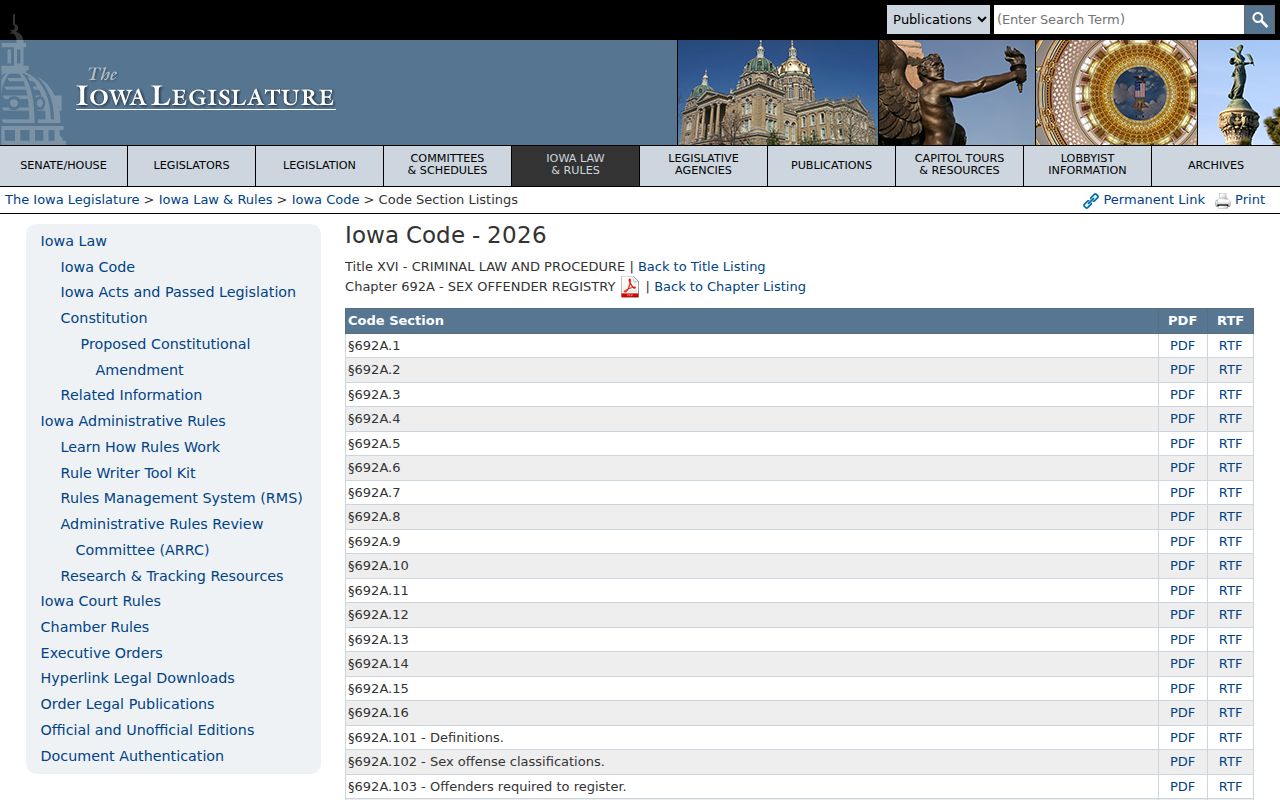
The statute view helps readers check the current law instead of relying on an old summary of Iowa registration duties.
| Iowa Tier | General Duration | Key Context |
|---|---|---|
| Tier I | 10 years | The qualifying offense controls; repeat tier-I history can raise the tier. |
| Tier II | 25 years | Repeat qualifying history can lead to tier III. |
| Tier III | Lifetime | Applies to the most serious or repeat classifications. |
Scott County Cross-River Registry Search
Scott County sits in a Quad Cities metro split by the Mississippi River and by state law. An Iowa map search stops at the legal and data boundary even when a nearby Illinois address is part of the same daily community. The Dru Sjodin National Sex Offender Public Website, or NSOPW, searches participating jurisdictions and provides the better cross-state layer. The Iowa profile remains the source for Iowa-specific detail.
The national registry search shows the participating-jurisdiction entry point used for a broader location check.
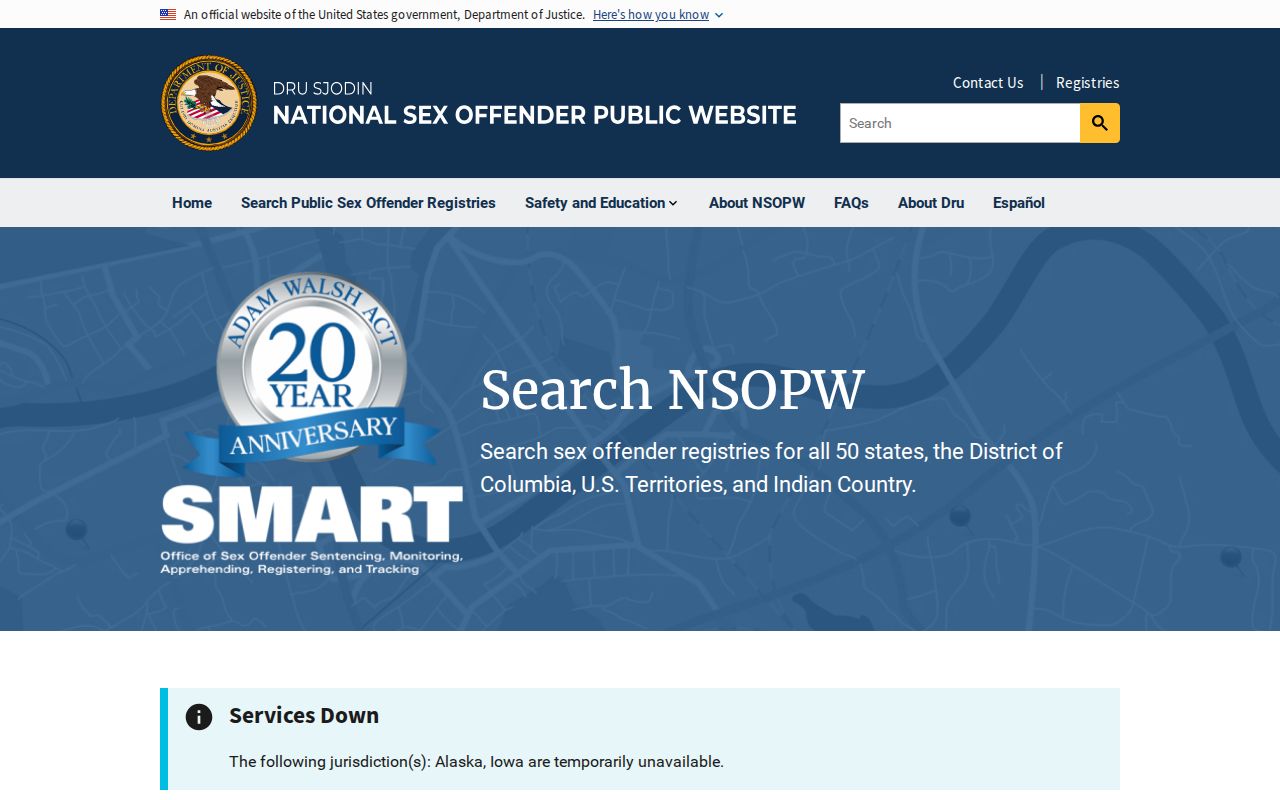
For a home, park, school route, or family visit near the river, checking both the Iowa source and NSOPW reduces the chance that a state line narrows the query.
Note: NSOPW is a cross-state index, while the Iowa registry and Scott County Sheriff remain the primary sources for an Iowa entry.
When a Scott County Profile Looks Stale
First reopen the profile and note the status and update context. Check the spelling, aliases, address, and county. Then repeat the search with a second method, such as a name plus aliases or a map query. If the data still appears wrong, contact the Scott County Sheriff or DCI. Provide the profile reference and the fact that seems out of date without sending more personal data than the agency needs.
Iowa Code section 692A.128 creates a limited court route for modification in qualifying cases. It is not automatic expiration, and the sheriff cannot grant it through a phone call. Iowa's presence and residency restrictions in section 692A.114 also require care. A map pin alone does not answer every statutory question involving a school or child-care facility.
Using Registry Information Lawfully
Registry data supports safety awareness, careful planning, and official reporting. It should be checked against the current government profile. A listing does not authorize surveillance, threats, public shaming, or contact with a registrant or household. If a Scott County address or status raises a compliance concern, send it to the sheriff or DCI and let the responsible agency assess it.
Use the registry lawfully: Iowa Code chapter 692A prohibits using registry information to facilitate a crime. Harassment, threats, retaliation, or vigilantism are unlawful; verify concerns with the Scott County Sheriff instead of confronting anyone.
The registry also has limits. It lists people who meet Iowa's legal registration rules and shows the public fields permitted by law. It cannot promise that every risk appears, predict future conduct, or replace direct care in a pressing situation. Personal and family safety choices should use the registry as one source among ordinary precautions and emergency help when needed.