
Scott County Criminal History Checks
A sound Scott County search starts with the question the record must answer. Iowa Courts Online shows filed cases, docket events, judgments, and money entries. The sheriff's roster shows current custody and people housed during the prior seven days. The Iowa Division of Criminal Investigation, or DCI, supplies the state's fingerprint-supported criminal history product. These sources overlap, but they are not substitutes. A court search may show a case after the roster entry is gone, while a jail line may appear before the prosecutor files a charge.
Gather the full legal name, likely spelling variants, and a date of birth when the official form requires one. Avoid merging two people because a name looks alike. Then move through the sources in an order that preserves the difference between an allegation and an outcome.
- Search Iowa Courts Online by case number, or use a party name with Scott County selected.
- Review each charge, event, disposition, and judgment in the court file.
- Check the sheriff's roster or daily bookings for current or very recent custody.
- Ask the arresting agency for the incident report or arrest affidavit when the narrative matters.
- Order a DCI record check for statewide fingerprint-linked history, then seek a certified court copy when formal proof is needed.
Scott County's Three-Layer Record Check
The clerk, jail, and DCI each preserve a different stage. The Scott County Clerk of District Court holds the judicial file. Jail staff record intake, the committing agency, custody status, booking charges, and release data. DCI links arrest cycles to a statewide identity record through fingerprints and later disposition reports. Reading all three prevents a common error: treating the officer's arrest charge as the charge filed by the County Attorney or as the final judgment.
The county courthouse source shows where the court, clerk, prosecutor, and sheriff share one downtown campus. That close physical layout does not merge their legal duties.
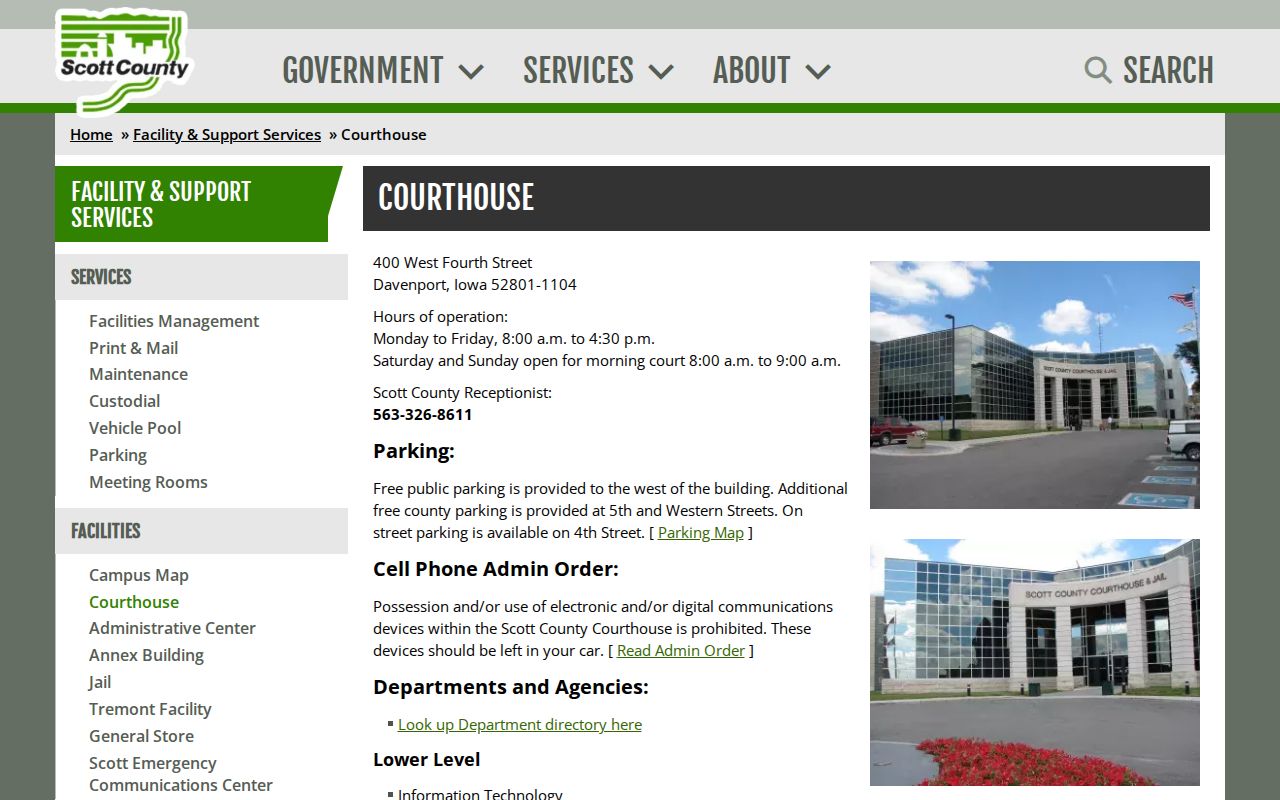
The courthouse image helps explain why a single visit can reach several counters, yet each Scott County record still must be requested from its own custodian.
| Source | Best answer | Main limit |
|---|---|---|
| Scott County Clerk | Filed charge, court events, and disposition | Some documents are protected or not downloadable |
| Scott County Jail | Recent booking, custody, and release | Public roster covers only current and seven-day custody |
| Iowa DCI | Statewide fingerprint-linked history | Release rules affect non-conviction information |
Official Background Checks in Iowa
The Iowa Department of Public Safety, Division of Criminal Investigation, Records and Identification Unit is the official state repository. Its Iowa criminal history record check costs $15 for each last name searched. First name, last name, and exact date of birth are required. The online route requires both the request and billing workflow. DCI also accepts requests by mail, fax, email, and in person, but not by phone.
A result may attach a releasable Iowa rap sheet or state that no Iowa criminal history was found with DCI. That second result can mean no record, no releasable record, or confidential juvenile information. Without signed authorization, DCI withholds completed deferred judgments and arrests more than 18 months old when no final disposition has been reported. For review of one's own national record, the FBI Identity History Summary uses its separate subject-only fingerprint process.
The DCI record-check page is the official source for current methods and limits.
This view points Scott County readers to the state product rather than treating a county docket or jail line as a complete background check.
| DCI item | Amount or rule |
|---|---|
| Name check | $15 per last name |
| Required identifiers | First name, last name, exact date of birth |
| Online submission | Request and billing forms both required |
| Scott County fingerprinting | By appointment at the jail; call first because no local fee was published |
Scott County Justice Campus Records
The Scott County Courthouse at 400 West Fourth Street in Davenport is headquarters for Iowa's Seventh Judicial District. Public clerk counters are on the first and second floors. The general clerk line is 563-326-8647, while traffic and criminal questions go to 563-326-8787. The County Attorney is on the second floor, court administration is on the third, and the sheriff occupies lower-level space. Weekday courthouse hours are 8:00 a.m. to 4:30 p.m.
The building is the third courthouse on the donated square. The county's official history traces the earlier public buildings, including the 1886 courthouse that settled into sandy soil, cracked, and lost its dome before demolition in 1955. Today's four-floor building later gained a larger magistrate courtroom, better access, and video court capability. Visitors must leave phones and digital communication devices in the car and pass security screening. A record request should still go to the clerk, sheriff, prosecutor, or court office that owns it.
Clerk of District Court
400 W. Fourth St.
Davenport, IA 52801
563-326-8647
Weekdays, 8:00 a.m.-4:30 p.m.
Traffic and Criminal Clerk
400 W. Fourth St.
Davenport, IA 52801
563-326-8787
Case and counter questions
Sheriff and Jail
400 W. Fourth St.
Davenport, IA 52801
563-326-8625
Sheriff weekdays, 8:00 a.m.-4:30 p.m.
Kinds of Criminal Records
Scott County criminal history is a chain of related files. A police or sheriff report describes the response and alleged facts. The jail creates a booking record after intake. The clerk opens the court case when a complaint, trial information, or other charging paper is filed. DCI keeps the statewide criminal-history cycle, and the Iowa Department of Corrections tracks state sentences and community supervision. The Iowa Sex Offender Registry is a separate public-safety system governed by chapter 692A.
Choose the source by record type, not by whichever search appears first.
- Incident or arrest report: request it from the agency whose officer created it.
- Booking record: use the Scott County jail tools or ask the sheriff for an older entry.
- Court case file: search Iowa Courts Online and obtain copies from the clerk.
- State criminal history: order the DCI product under Iowa's dissemination rules.
- Warrant or supervision record: verify through the sheriff, court, and Iowa DOC channel that controls the current status.
Scott County Jail Records Refresh
The sheriff's public inmate list covers people now housed in the Scott County Jail and those housed within the last seven days. It updates every ten minutes. A custom search accepts first and last name, committing agency, and custody status. Daily booking links cover today plus the prior six dates, sort the selected day's entries newest first, and show a last-upload time. These precise freshness signals are useful, but the county warns that the roster is not comprehensive and excludes federal prisoners or detainees.
The Scott County jail source documents the downtown complex and its public role.
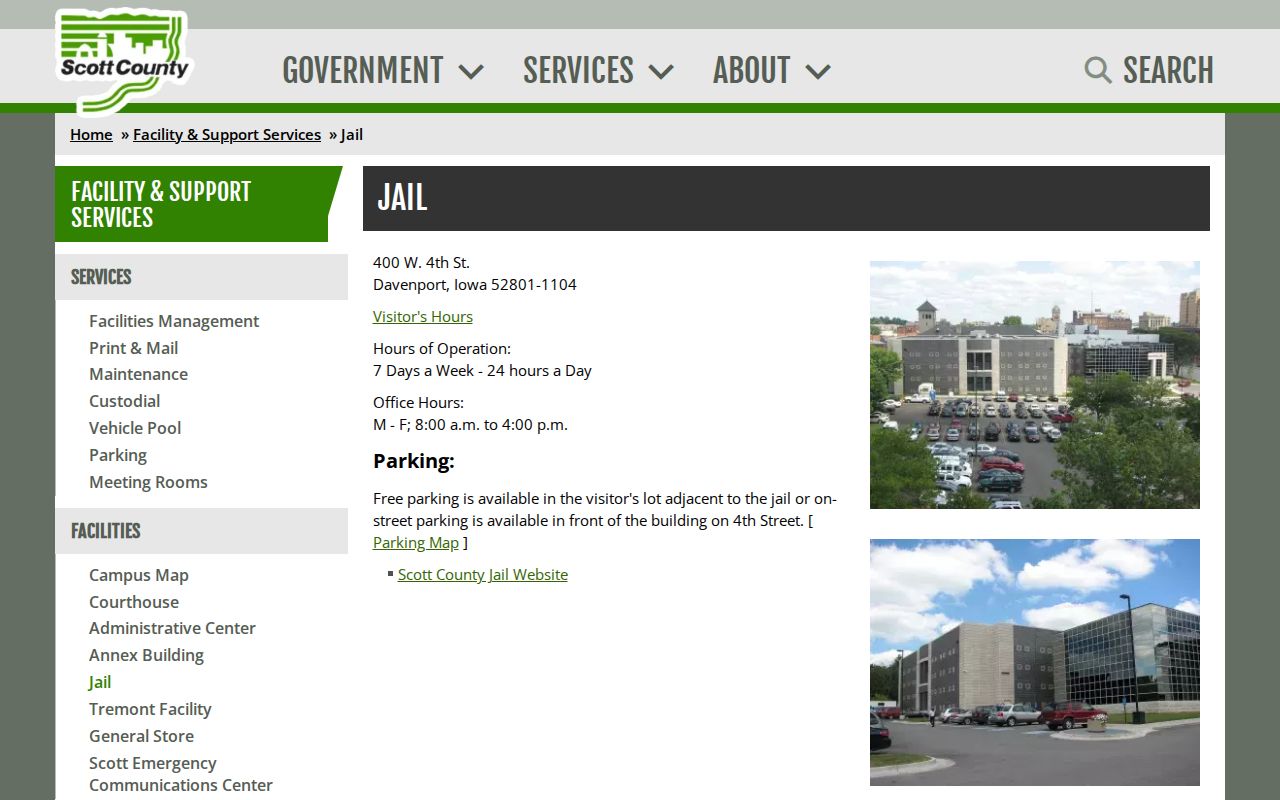
The active complex has a 365-person capacity; the separate 134-bed figure describes the older historic segment, not the whole present operation. The Tremont facility now serves storage and community-restoration functions rather than operating as the former minimum-security annex.
A release timestamp proves that the person left that custody entry. It does not show that the court dismissed the case. When a booking is older than seven days, request booking data from the sheriff, the incident narrative from the arresting agency, and the filed outcome from the clerk.
Note: The roster's ten-minute refresh describes publication speed, not completeness, identity certainty, or proof of guilt.
Scott County Criminal Records: What They Contain
A DCI rap sheet is organized around identity and fingerprint-linked arrest cycles. A Scott County court file is arranged around a case number, parties, counts, filings, hearings, orders, judgment, and financial entries. A booking entry instead centers on immediate custody. Those formats explain why the same event may show different wording or dates without any custodian necessarily making an error.
Read each charge and disposition separately. One count may be dismissed while another results in judgment. Protected identifiers, victim and minor information, medical data, sealed matters, and confidential evaluations do not appear like ordinary public fields.
| Name and identifiers | Legal name, aliases, date of birth, demographic data, and agency identifiers when law permits release |
|---|---|
| Arrest and booking | Arrest date, agency, intake time, committing agency, booking charge, bond, custody, and release data |
| Charges and statutes | Filed counts, Iowa citation, offense level, and charge status |
| Disposition | Dismissal, acquittal, deferred judgment, conviction, or another count-level outcome |
| Sentence | Custody, probation, fines, costs, restitution, and later court action when public |
| Supervision | Iowa DOC prison or Seventh District community supervision information that is public |
Scott County Charges and Dispositions
Three facts deserve separate labels. The arrest charge records what the officer alleged at custody. The filed charge reflects the County Attorney's decision and appears in Iowa District Court. The disposition records how the count ended. A trial information, Iowa's common formal charging instrument for an indictable offense, may differ from the booking line. Later amendment, dismissal, plea, trial, or deferred judgment can change the legal picture again.
Case codes also help. FECR commonly marks a felony criminal case, while AGCR and SRCR identify other criminal case categories in Iowa's system. Use the docket detail, not the caption alone, to confirm the current level and status.
- Arraignment
- The proceeding where charges and a plea are addressed.
- Disposition
- The count-level result, such as dismissal, acquittal, deferred judgment, or conviction.
- Deferred judgment
- An Iowa outcome that defers judgment while conditions are completed; court and DCI treatment can differ.
- Mittimus
- A court direction that commits a person to custody.
Iowa Public Access Laws
Iowa's Open Records Law allows examination and copying of government records, subject to reasonable actual costs and specific confidentiality rules. It does not make intelligence files, active investigative material, juvenile information, protected personal data, or expunged matters open. Ask the office that created the record, describe a narrow date or case range, request electronic delivery when practical, and seek a cost estimate before chargeable work begins.
Criminal-history dissemination has separate rules. Signed authorization changes which deferred and unresolved arrest information DCI may release. Court access follows Judicial Branch rules, while registry publication follows chapter 692A.
Key Iowa authorities:
Iowa Code chapter 22 grants record access and lists confidential categories.
Iowa Code chapter 692 governs criminal-history dissemination, access, and correction.
Iowa Code chapter 901C sets outcome-specific expungement routes.
Iowa Code chapter 692A governs registration and public registry information.
Scott County Warrant and Supervision Records
Scott County publishes a public warrant search, but web data can lag a service, recall, or court order. A person resolving a possible warrant should verify it with the sheriff at 563-326-8625 or the traffic and criminal clerk at 563-326-8787. Iowa Courts Online may show a related failure-to-appear or bench-warrant entry. The issuing court controls the case, and the sheriff controls service information.
Probation and parole are state-administered here. Iowa DOC's Seventh District, headquartered at 605 Main Street in Davenport, provides probation, parole, pretrial, residential, Drug Treatment Court, OWI treatment, and related services. The Iowa DOC Offender Search can help identify state custody or supervision, while a Scott County docket shows the sentence and public violation litigation.
The Iowa DOC Seventh District source shows the local corrections office and its programs.
This state channel fills a gap that neither the county jail roster nor a court caption can answer by itself.
Scott County Cross-River Record Searches
The Quad Cities feel like one community, but the Mississippi marks a firm records boundary. A Davenport or Bettendorf event belongs to Iowa agencies and courts. An event across the river belongs to Illinois custodians, even when the places are only minutes apart. Iowa Courts Online cannot supply an Illinois case, and the Scott County jail roster does not cover custody in Rock Island County. The same split matters for warrants, prison records, and police reports.
Start with the location where the event occurred. For registry awareness near the river, the U.S. Department of Justice's national search can bridge participating jurisdictions, but the Scott County sex offender lookup explains why the Iowa profile remains the source for Iowa details. Geography should guide the first search, not a person's usual home or the nearest courthouse.
Restricted, Sealed & Expunged Records
Iowa uses outcome-specific expungement rules. Section 901C.2 addresses qualifying dismissals and acquittals. Section 901C.3 creates a limited one-time route for certain misdemeanor convictions after more than eight years, with no pending charge and other conditions met. Its exclusions are extensive. Scott County applicants file in the District Court case and should review the current statute and Judicial Branch forms before relying on a broad summary.
An expungement order makes qualifying information confidential; it does not mean every government trace was physically destroyed. The clerk notifies DPS, and the statute directs specified DCI treatment. Fingerprints may remain in the identification system. A discharged deferred judgment also does not automatically vanish from DCI: the agency treats it as a non-conviction and releases it only with signed authorization.
Start with the full docket and a DCI self-check. Confirm the exact result, statute, and paid obligations, then ask the Scott County Clerk about the current application and fee because no reliable local fee was found in the official sources reviewed. Recheck the public docket and DCI record after an order is processed.
Scott County Criminal Record Custodians
The sheriff is the right source for a sheriff-created report, jail booking file, or releasable warrant information. Davenport, Bettendorf, and Eldridge police keep their own incident narratives. The jail may show that a city agency committed a person, but it does not inherit every police investigation file. The clerk controls the court docket and certified copies. DCI controls the statewide rap sheet.
The Scott County Attorney source identifies the local prosecution office at the courthouse.
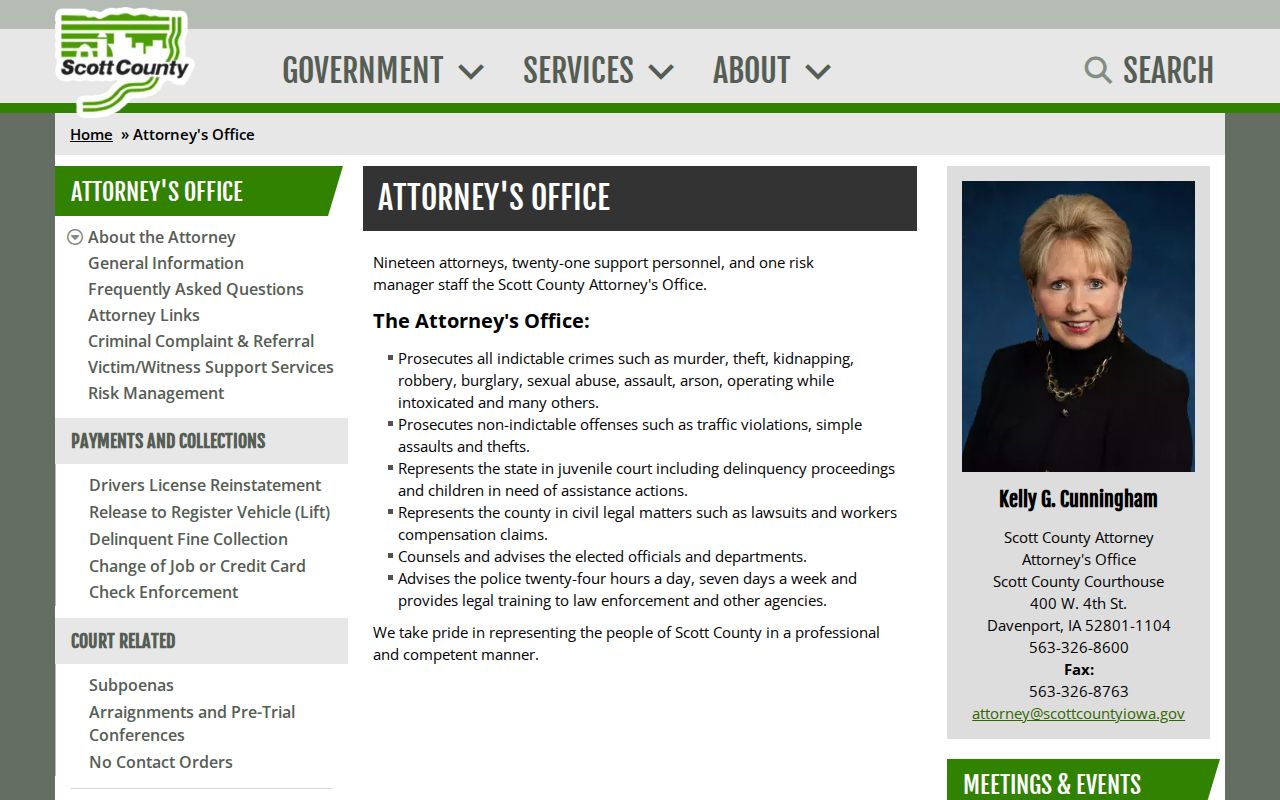
The prosecutor decides what charges to file, but the clerk remains the official custodian of the court record.
When the desired file is not online, a chapter 22 request needs no magic phrase. Give the event type, case or incident number if known, date and place, originating agency, desired format, and a narrow scope. Ask for a cost estimate. If access is denied, request the legal basis and consult the Iowa Public Information Board for guidance.
City-by-City Criminal Records in Scott County
Davenport, Bettendorf, and Eldridge are Scott County's three largest incorporated cities. Each police department creates its own report, while city arrests generally move to the county jail and filed criminal matters enter the unified Iowa District Court system. Iowa does not give these cities separate municipal criminal court databases. The city pages keep the police request route at city altitude, then show where county and state records continue the trail.
The 2020 Census comparison counted 101,724 people in Davenport, 39,102 in Bettendorf, and 6,726 in Eldridge. Those figures identify the ranked page set and should not be mixed with a newer estimate without labeling the year.
Davenport Record Check
101,724 · JustFOIA requests, city police reports, county bookings, and unified court records
Bettendorf Record Check
39,102 · Police Request Information route, county jail records, and Iowa Courts Online
Eldridge Record Check
6,726 · Direct police contact, annual reports, county custody, and state court files